

NAD+ for Skin Health: Beauty Starts at the Cellular Level
How NAD+ supports skin cell renewal, DNA repair, and collagen production — plus why resveratrol's antioxidant power matters for aging skin.

By Sarah Mitchell

Key takeaways
- —Skin aging is fundamentally a story of cellular energy decline and accumulated DNA damage
- —NAD+ fuels the DNA repair enzymes (PARPs) that keep skin cells functioning properly
- —Healthy NAD+ levels support the cellular energy needed for skin cell turnover and renewal
- —Resveratrol provides potent antioxidant protection against UV-induced oxidative damage
- —"Beauty from within" isn't just a marketing phrase — it's a description of how cellular health determines skin quality
Why Your Skin Ages: The Story Beneath the Surface
Walk into any department store and you'll find hundreds of products promising younger-looking skin. Serums, creams, masks, peels — most of them working exclusively on the surface. And while topical skincare has its place, it addresses only half the equation.
Your skin is your body's largest organ, and like every organ, it's made of cells. Those cells need energy to divide, repair, and renew themselves. They need functional DNA repair systems to fix the damage caused by UV exposure, pollution, and normal metabolic processes. And they need protection from the oxidative stress that accelerates visible aging.
All of these processes depend on what's happening *inside* the cell — not on what you apply to the outside.
The Energy Problem: Why Tired Cells Make Tired Skin
Your skin cells are among the most metabolically active in your body. The epidermis (outer layer) completely renews itself roughly every 28 days in young adults. That means billions of new cells must be produced, differentiated, and moved to the surface on a continuous cycle.
This renewal process is energy-intensive. Every step — from stem cell division in the basal layer to the production of structural proteins like keratin — requires ATP, your cells' energy currency. And ATP production depends directly on NAD+.
As NAD+ levels decline with age (roughly 50% by age 50), cellular energy production slows. The impact on skin is visible:
- —Slower cell turnover — Instead of renewing every 28 days, the cycle extends to 40, 50, even 60+ days. The result is a duller, less even complexion as old cells linger on the surface longer.
- —Reduced repair capacity — Skin cells that lack energy can't maintain themselves as effectively, leading to accumulated micro-damage.
- —Thinner epidermis — With fewer new cells being produced, the skin gradually becomes thinner and more fragile.
Supporting NAD+ levels may help maintain the cellular energy supply that keeps this renewal cycle running closer to its youthful pace.
DNA Repair: The Invisible Foundation of Healthy Skin
Your skin is constantly under assault. UV radiation from sunlight is the primary external threat — it directly damages DNA in skin cells, creating lesions that must be repaired to prevent mutations and maintain normal cell function.
The enzymes responsible for detecting and repairing this DNA damage are called PARPs (poly-ADP-ribose polymerases). And PARPs have an absolute requirement: NAD+ is their sole substrate. Every time a PARP enzyme repairs a DNA break, it consumes NAD+.
This creates a particular problem for skin. As the organ most exposed to UV radiation, skin experiences more DNA damage than almost any other tissue. At the same time, age-related NAD+ decline means less fuel is available for the repair enzymes that fix this damage.
The consequence is a growing backlog of unrepaired DNA damage. Over time, this contributes to:
- —Impaired cellular function — Cells with accumulated DNA damage don't perform as well, affecting everything from collagen production to melanin regulation
- —Increased cellular senescence — Heavily damaged cells stop dividing and become "senescent," releasing inflammatory signals that affect surrounding healthy cells
- —Uneven pigmentation — DNA damage in melanocytes (pigment-producing cells) can lead to age spots and irregular skin tone
By supporting NAD+ levels, you help ensure that PARP enzymes have the fuel they need to keep pace with the DNA damage your skin experiences daily.
Collagen and the Cellular Energy Connection
Collagen — the structural protein that gives skin its firmness and elasticity — is produced by cells called fibroblasts in the dermis (deeper skin layer). Collagen production is an energy-intensive process that requires fibroblasts to be metabolically active and well-supplied with ATP.
When cellular energy declines, fibroblast activity slows. Less collagen is produced, and the existing collagen network isn't maintained as effectively. This is one reason why collagen production drops roughly 1-1.5% per year after age 25 — it's not just about the collagen itself, but about the energy available to the cells that make it.
NAD+ also influences collagen maintenance through the sirtuin pathway. SIRT1, which requires NAD+ to function, helps regulate the inflammatory signals (particularly NF-κB) that drive collagen breakdown. When SIRT1 activity is low due to insufficient NAD+, inflammatory collagen degradation may accelerate.
This is where internal supplementation and topical skincare can complement each other. Topical retinoids and peptides stimulate collagen production from the outside. Adequate NAD+ levels support the cellular energy that fibroblasts need to actually respond to those signals from the inside.
Resveratrol: Antioxidant Protection for Skin Cells
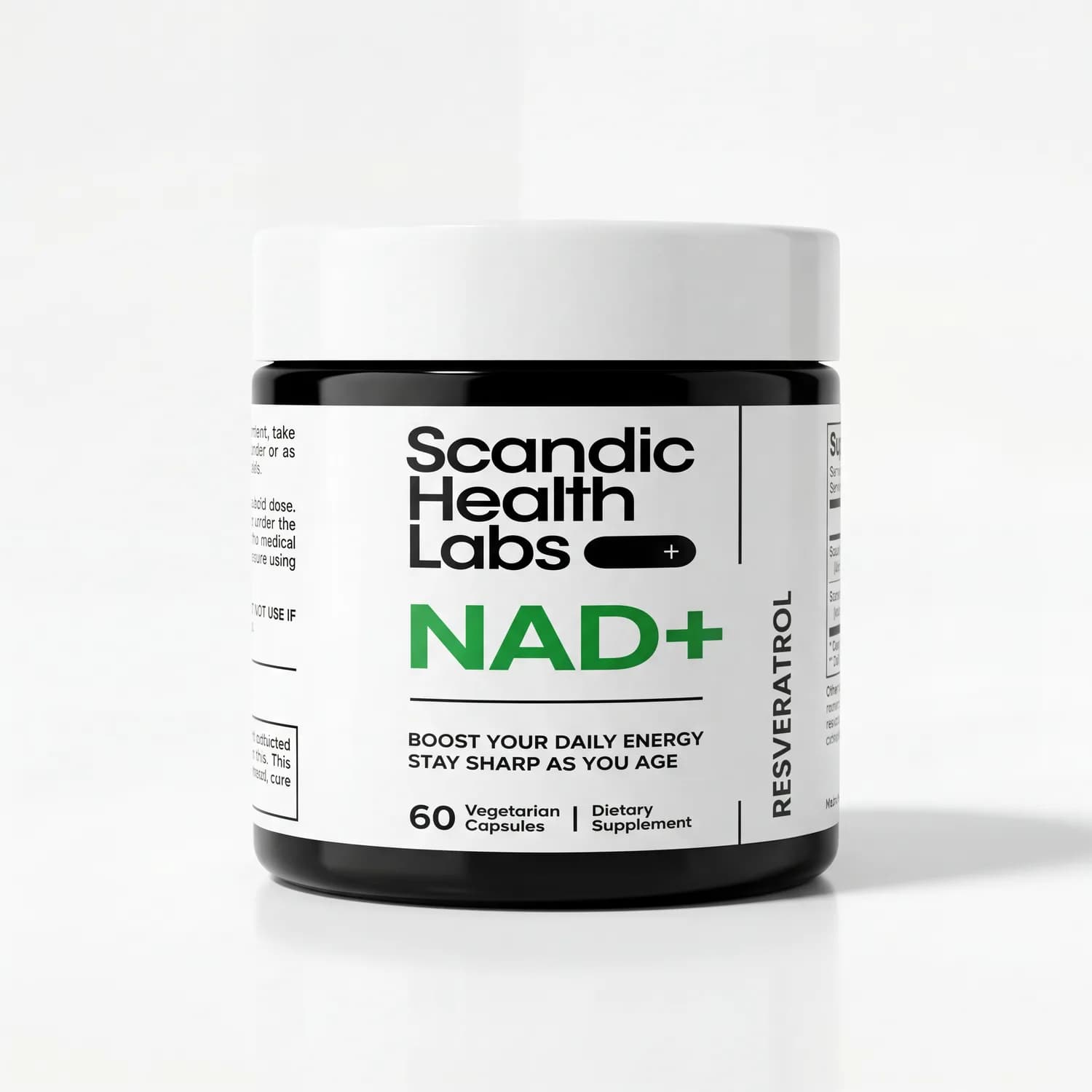
The trans-resveratrol in the Scandic Health Labs NAD+ formula provides a second layer of skin support through its potent antioxidant properties.
UV radiation generates reactive oxygen species (ROS) — unstable molecules that damage cellular structures including DNA, proteins, and the lipid membranes that protect cells. This oxidative stress is one of the primary drivers of photoaging: the premature skin aging caused by sun exposure.
Resveratrol is a powerful polyphenol that neutralises ROS directly. But its antioxidant effects go beyond simple scavenging:
Activating the cellular antioxidant response
Through SIRT1 activation, resveratrol helps upregulate your cells' own antioxidant defence systems. SIRT3, activated downstream, turns on SOD2 — a mitochondrial enzyme that neutralises superoxide, one of the most damaging free radicals.
Anti-inflammatory effects
Resveratrol inhibits the NF-κB inflammatory pathway, reducing the chronic low-grade inflammation ("inflammaging") that accelerates skin aging. This same inflammation drives both collagen breakdown and NAD+ depletion, so controlling it provides compound benefits.
Complementing sun protection
Resveratrol doesn't replace sunscreen — nothing does for direct UV protection. But by strengthening cellular antioxidant defences and reducing inflammation, it may help limit the oxidative damage that occurs even with good sun protection habits. Think of it as an internal complement to external UV defence.
Beauty From Within: Not a Trend, a Biological Reality
The "beauty from within" concept has been around for decades in wellness circles. What's changed is that we now understand the specific cellular mechanisms involved.
Visible skin quality — radiance, evenness, firmness, texture — is a downstream expression of cellular health. Cells that have adequate energy, functional DNA repair, active collagen production, and strong antioxidant defences produce healthier skin. Cells that are energy-depleted, burdened with DNA damage, and overwhelmed by oxidative stress produce skin that looks tired, uneven, and aged beyond its years.
This isn't about choosing between topical skincare and internal supplementation. It's about recognising that both matter:
- —Topical products work on the surface and uppermost skin layers — delivering active ingredients directly where they're needed
- —Internal cellular support works on the deeper machinery — ensuring skin cells have the energy, repair capacity, and protection to function well
The most effective approach combines both. A thoughtful topical routine addresses the outside. Supporting your NAD+ levels addresses the inside.
A Simple Internal Skincare Protocol
- Support your cellular foundation — NAD+ supplementation supports the energy production, DNA repair, and sirtuin activity that underpin skin cell health
- Protect from UV damage — Daily broad-spectrum SPF remains the single most important anti-aging step. Resveratrol's antioxidant properties provide an internal complement
- Stay hydrated — Your skin cells need water to function. Adequate hydration supports the enzymatic reactions that depend on NAD+
- Prioritise sleep — Skin repair ramps up during deep sleep. Poor sleep accelerates NAD+ decline and reduces the window for cellular repair
- Eat antioxidant-rich foods — Berries, leafy greens, and oily fish support both NAD+ metabolism and antioxidant defences
The Cellular Approach to Skin Health
Great skin isn't just about what you put on it. It's about what's happening inside the cells that make it. NAD+ supports the energy production, DNA repair, and protective pathways that keep skin cells functioning at their best. Trans-resveratrol adds potent antioxidant protection and sirtuin activation that may help defend against the oxidative damage that drives visible aging.
Scandic Health Labs NAD+ delivers 500 mg NAD+, 250 mg 99% trans-resveratrol, 150 mg niacinamide, and 100 mg TMG — a synergistic formula that supports your skin health from the cellular level up. Two capsules daily, with a meal. Because the most effective skincare routine starts inside your cells.
6 min read