

NAD+ and Exercise: How Cellular Energy Fuels Your Workout Recovery
A 2021 study of 48 runners found NAD+ supplementation improved aerobic capacity and recovery. Here's how NAD+ supports mitochondria, ATP production, and exercise performance.

By Sarah Mitchell

Key takeaways
- —NAD+ is essential for mitochondrial ATP production — the energy source your muscles depend on during exercise
- —A 2021 clinical trial (Liao et al.) with 48 amateur runners showed NAD+ supplementation improved aerobic capacity, oxygen utilization, and recovery
- —NAD+ supports mitochondrial biogenesis — your body's ability to build new, more efficient power generators in response to training
- —Combining NAD+ supplementation with consistent training may support better adaptation and faster recovery
The Cellular Engine Behind Every Rep and Every Mile
Whether you run, lift, cycle, swim, or do CrossFit, every physical effort you make depends on one thing at the cellular level: ATP. Adenosine triphosphate is the energy currency that powers muscle contractions, and your body produces it primarily inside mitochondria — the small organelles often called the powerhouses of the cell.
Here is where NAD+ enters the picture. NAD+ is the central electron carrier in oxidative phosphorylation, the metabolic process that generates the vast majority of your ATP. Without NAD+, the electron transport chain in your mitochondria stalls. Energy production drops. Performance suffers.
For casual exercisers, this might show up as feeling gassed earlier in a workout. For serious athletes, it can mean the difference between hitting a new personal best and plateauing for months.
What the Runner Study Showed
In 2021, Liao et al. published a clinical trial that put NAD+ supplementation to the test in an athletic population. The study enrolled 48 amateur runners and measured the effects of NAD+ precursor supplementation on exercise performance.
The results were meaningful:
- —Improved aerobic capacity — participants showed better VO2 performance, a key measure of cardiovascular fitness
- —Enhanced oxygen utilization — the body became more efficient at using available oxygen during exercise
- —Increased stamina — runners maintained higher intensity for longer
- —Better recovery markers — signs of faster post-exercise recovery compared to the control group
This was not a study on elite athletes with optimized everything. These were regular people who run — the kind of people who might train for a half marathon or join a local running club. The fact that supplementation made a measurable difference in this population is encouraging, because it suggests the benefits are accessible, not just relevant at the margins of elite performance.
How NAD+ Supports Exercise at the Cellular Level
The Liao study results make sense when you look at what NAD+ does inside muscle cells. There are four key mechanisms connecting NAD+ to exercise performance and recovery.
1. ATP Production
This is the most direct connection. Your mitochondria use NAD+ as an electron shuttle in the process of converting nutrients into ATP. During intense exercise, ATP demand skyrockets — your muscles may use ATP hundreds of times faster than at rest.
When NAD+ levels are adequate, the electron transport chain runs efficiently and ATP production keeps pace with demand. When NAD+ is depleted — which happens both acutely during exercise and chronically with age — the system bottlenecks. You feel it as fatigue, reduced power output, and that sensation of your muscles just not responding the way they should.
2. Mitochondrial Biogenesis
Here is something that matters enormously for long-term athletic development: NAD+ does not just help existing mitochondria produce energy. It supports the creation of entirely new mitochondria.
NAD+ activates SIRT1 and SIRT3, sirtuin enzymes that regulate mitochondrial biogenesis — the process by which your cells build more mitochondria in response to training demands. This is one of the central adaptations that makes you fitter over time. More mitochondria means more energy-producing capacity per cell, which translates to better endurance, more power, and greater metabolic flexibility.
A 2013 study from the Sinclair lab at Harvard (Gomes et al.) demonstrated that restoring NAD+ levels reversed age-related mitochondrial dysfunction. For athletes, this suggests that maintaining NAD+ levels may support the mitochondrial adaptations that training is designed to stimulate.
3. Reduced Inflammation
Intense exercise creates inflammation. In moderation, that is actually a good thing — acute inflammation after training is part of the adaptation signal that makes you stronger. But when inflammation becomes excessive or chronic, it impairs recovery, increases injury risk, and can lead to overtraining syndrome.
NAD+ plays a role in regulating the inflammatory response. A 2026 study found that high-dose NAD+ supplementation reduced inflammatory signals after intense exercise. NAD+ fuels SIRT1, which in turn suppresses NF-kB, a master regulator of inflammatory gene expression.
The combination with resveratrol — a potent NF-kB inhibitor in its own right — may provide additional anti-inflammatory support. This is particularly relevant for athletes training at high volumes who need to manage the cumulative inflammatory load of repeated hard sessions.
4. Faster Cellular Repair
Exercise creates microscopic damage to muscle fibers, connective tissue, and even DNA. This damage is not a problem — it is the stimulus for adaptation. But repairing that damage requires energy and functional repair machinery.
NAD+ is the sole fuel for PARP enzymes, which detect and repair DNA damage. It also supports the broader cellular repair processes that happen during recovery. When NAD+ is abundant, repair happens efficiently. When it is depleted, recovery takes longer, and you enter your next training session without fully rebuilding from the last one.
This is especially relevant for athletes over 30, when NAD+ levels are already declining naturally and recovery capacity noticeably starts to slow.
NAD+ and the Training Adaptation Cycle
To put this all in context, here is how NAD+ fits into the training cycle that every athlete experiences:
- Training stimulus — You exercise at an intensity that challenges your current capacity
- Cellular stress — Muscles deplete ATP, create oxidative stress, sustain micro-damage, and trigger inflammation
- Recovery and repair — Your body repairs damage, clears metabolic waste, and rebuilds stronger (this phase needs NAD+ for energy, DNA repair, and inflammation control)
- Adaptation — Mitochondrial biogenesis, improved enzyme activity, and structural changes make you fitter (NAD+ fuels sirtuin activation that drives this process)
NAD+ supports steps 2 through 4. It does not replace training — nothing does. But it may support the cellular processes that determine how effectively your body responds to training.
Practical Recommendations for Active People
Based on the current evidence, here is how to think about NAD+ as part of an active lifestyle:
- —Take it consistently, not just on training days. NAD+ supports recovery and adaptation, which happen on rest days. The benefits come from sustained elevated levels, not acute dosing.
- —Morning with a meal is optimal. NAD+ supports circadian rhythm regulation and energy production. Taking it in the morning aligns with your body's natural metabolic rhythm. The resveratrol in a complete formula absorbs better with some dietary fat.
- —Do not expect it to replace fundamentals. Sleep, nutrition, hydration, and smart programming matter more than any supplement. NAD+ supports the cellular machinery that these fundamentals depend on.
- —Give it time. The Liao runner study ran for multiple weeks. Blood NAD+ levels rise within days, but the downstream effects on mitochondrial biogenesis and training adaptation take weeks to become noticeable. Think 4-8 weeks minimum.
- —It may matter more as you get older. If you are over 35 and noticing that recovery takes longer than it used to, declining NAD+ levels are a plausible contributor. Supporting those levels through supplementation may help close the gap.
Beyond NAD+ Alone
Exercise enthusiasts often already take a stack of supplements — protein, creatine, omega-3s, vitamin D. NAD+ fits comfortably alongside these because it operates at a different level. Where protein provides building materials and creatine supports short-burst energy, NAD+ supports the fundamental cellular processes that everything else depends on.
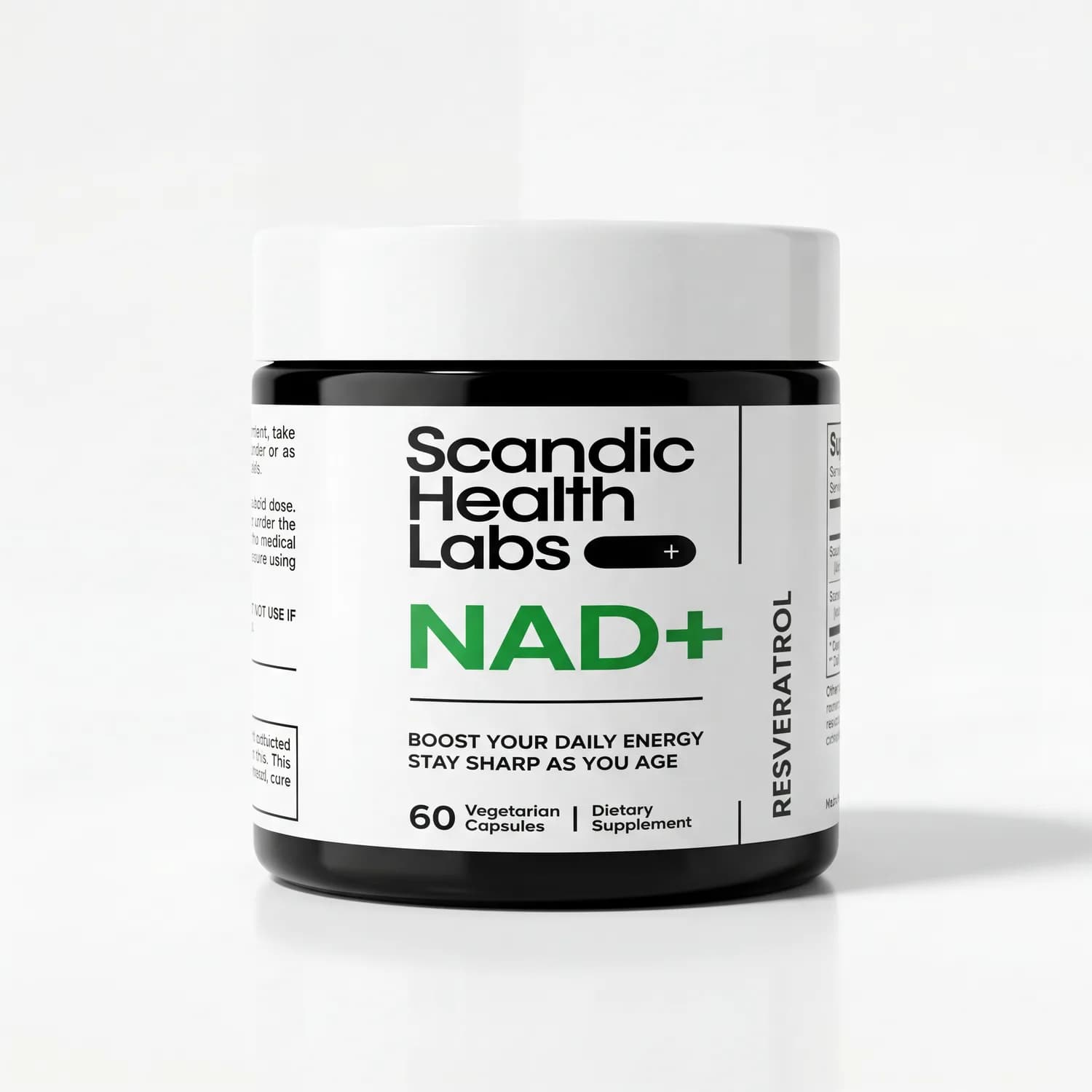
The Scandic Health Labs NAD+ formula is designed with active people in mind. The 500 mg NAD+ supports mitochondrial energy production. The 250 mg trans-resveratrol activates the sirtuin enzymes that drive mitochondrial biogenesis and control inflammation. The niacinamide keeps the NAD+ recycling pathway running between doses. And the TMG ensures methylation stays balanced — important for anyone pushing their body hard on a regular basis.
The Bottom Line
Your fitness is built in recovery, not just in the gym. Every adaptation — every new mitochondrion, every repaired muscle fiber, every improvement in your cardiovascular system — depends on cellular processes that require NAD+.
The Liao 2021 runner study showed that supplementation can make a measurable difference in real athletes doing real training. The mechanism makes biological sense: more NAD+ means more efficient energy production, better mitochondrial adaptation, managed inflammation, and faster cellular repair.
NAD+ supplementation is not a shortcut. It is support for the cellular machinery that turns your hard work into results.
7 min read