

The Science of Healthy Aging: What Clinical Studies Say About NAD+
A clear-eyed look at the human clinical evidence for NAD+ supplementation — what the studies found, what they did not, and what it means for you.

By Sarah Mitchell

Key takeaways
- —Multiple human clinical trials have now tested NAD+ precursors for metabolic health, cardiovascular function, physical performance, and cognitive outcomes
- —The results are promising and consistent in direction, though study sizes remain relatively small
- —The strongest evidence so far points to benefits for insulin sensitivity, arterial health, and exercise performance
- —Honesty about what we know — and what we do not yet know — is the foundation of responsible supplementation
From Lab Bench to Human Evidence
For years, NAD+ research lived almost entirely in animal models. Mice studies showed dramatic results: reversed ageing markers, restored mitochondrial function, extended lifespan. The question was always whether any of this would translate to humans.
Over the past five years, it has started to. A growing number of randomised, controlled human trials have tested NAD+ precursors — NMN, NR, and direct NAD+ — in real people, with real endpoints. The results are not as dramatic as the mouse studies (they rarely are), but they are consistent, measurable, and pointing in the same direction.
Here is what the key studies found.
Yoshino et al. (2021) — Insulin Sensitivity
The study: Conducted at Washington University School of Medicine, this randomised, placebo-controlled, double-blind trial enrolled postmenopausal women with prediabetes. Participants received 250 mg/day of an NAD+ precursor or placebo for 10 weeks.
What they found: The supplementation group showed approximately 25% improvement in muscle insulin sensitivity, as measured by the hyperinsulinemic-euglycemic clamp technique — the gold standard for measuring insulin sensitivity. The researchers also observed favourable changes in gene expression related to lipid metabolism and muscle remodelling.
Why it matters: Insulin resistance is one of the hallmarks of metabolic ageing. This was the first well-designed human trial to show that NAD+ precursor supplementation could meaningfully improve a core metabolic parameter. The effect size — 25% — is clinically significant.
What to keep in mind: The study was small (25 participants) and focused specifically on postmenopausal women with prediabetes. We do not yet know whether the same magnitude of effect applies to younger people, men, or those with normal insulin sensitivity.
Igarashi et al. (2022) — Arterial Stiffness
The study: A randomised, double-blind, placebo-controlled trial conducted at Keio University in Japan. Healthy middle-aged and older adults received 250 mg/day of an NAD+ precursor for 12 weeks.
What they found: The supplementation was well tolerated with no serious adverse events. Blood NAD+ metabolite levels rose significantly. Most notably, the study observed a potential reduction in arterial stiffness — a key marker of cardiovascular ageing. Arterial stiffness increases with age and is an independent predictor of cardiovascular events.
Why it matters: Cardiovascular ageing is one of the most consequential aspects of getting older. If NAD+ supplementation can genuinely slow arterial stiffening, the downstream implications for heart health and longevity could be substantial.
What to keep in mind: The arterial stiffness finding was exploratory rather than a primary endpoint. Larger, longer trials specifically designed to measure cardiovascular outcomes are needed to confirm this effect.
Yi et al. (2023) — Physical Function and Walking Capacity
The study: A multi-centre, randomised controlled trial involving 80 middle-aged adults. Participants received NAD+ precursor supplementation at doses ranging from 300 to 900 mg/day.
What they found: Supplementation significantly raised NAD+ levels in blood. More importantly, participants showed meaningful improvement on the six-minute walking test — a validated measure of functional exercise capacity used in clinical medicine. Higher doses (600–900 mg) showed greater effects than lower doses (300 mg).
Why it matters: The six-minute walking test is a practical, real-world measure. It reflects the kind of physical capacity that determines whether you can keep up with daily life as you age — climbing stairs, walking to the shops, playing with grandchildren. This study connected NAD+ supplementation to a tangible, functional outcome.
What to keep in mind: The study duration was relatively short. Whether these improvements in walking capacity persist and translate to long-term health outcomes is an open question.
Liao et al. (2021) — Exercise Performance in Runners
The study: A clinical trial involving 48 amateur runners who received NAD+ precursor supplementation alongside their regular training.
What they found: The supplementation group showed improved aerobic capacity, better oxygen utilisation, increased stamina during endurance tests, and faster recovery compared to the control group.
Why it matters: Athletes and active individuals are often the first to notice subtle changes in cellular efficiency. This study suggests that NAD+ supplementation may support not just baseline health but active performance — the ability to train harder and recover faster.
What to keep in mind: Amateur athletes are a specific population. They tend to be healthier and more metabolically active than average, which means the results may not directly generalise to sedentary individuals.
Gomes and Sinclair (2013) — The Pseudohypoxic State
The study: This foundational research from David Sinclair's lab at Harvard Medical School was conducted in mice but established the mechanistic framework that underpins much of the human research that followed.
What they found: Declining NAD+ levels in ageing tissue disrupt communication between the cell nucleus and mitochondria, creating what the researchers termed a "pseudohypoxic state" — the cell behaves as if it is starved of oxygen even when oxygen supply is normal. This disruption is driven by reduced SIRT1 activity (which requires NAD+ to function) and leads to mitochondrial dysfunction, impaired energy production, and accelerated ageing.
Why it matters: This paper provided the "why" behind NAD+ supplementation. It showed that ageing is not just wear and tear — it is partly a communication breakdown within cells, and NAD+ is the signal molecule that keeps that communication intact. Critically, the researchers showed that restoring NAD+ levels reversed the pseudohypoxic state in aged tissue, restoring more youthful mitochondrial function.
What to keep in mind: This was an animal study. The mechanistic insights are well-accepted, but direct extrapolation to human outcomes requires the kind of clinical trials described above. The good news is that human trials are now validating the direction of these findings.
Kiss et al. (2019) — Cognitive Function and Neurovascular Health
The study: Researchers at the University of Oklahoma tested NAD+ precursor supplementation in aged mice, focusing on cerebrovascular function and cognitive outcomes.
What they found: Supplementation rescued cerebromicrovascular endothelial function and restored neurovascular coupling — the brain's ability to direct blood flow to active regions. This led to significant improvements in spatial working memory and gait coordination.
Why it matters: Cognitive decline is one of the most feared aspects of ageing. This study showed that NAD+ may support brain function not by acting directly on neurons but by restoring the vascular infrastructure that keeps them supplied with blood and oxygen. A 2025 follow-up study in humans with subjective cognitive decline showed improvements in cognitive biomarkers and Alzheimer's-related markers, though this data is still very early.
What to keep in mind: The core Kiss et al. study is in mice. The 2025 human data is preliminary. Cognitive endpoints are notoriously difficult to measure in clinical trials, and larger studies with longer follow-up are essential before drawing firm conclusions.
The Synergy Factor: Why Co-Ingredients Matter
One important nuance that individual studies do not always capture is the role of co-ingredients. Most clinical trials test a single NAD+ precursor in isolation. But laboratory research suggests that combining NAD+ with trans-resveratrol produces significantly higher NAD+ levels than either alone — 1.59x in heart tissue and 1.72x in skeletal muscle.
This aligns with the theoretical framework: NAD+ fuels the sirtuin enzymes, while resveratrol activates them. Having fuel without activation (or activation without fuel) limits the potential benefit. Similarly, TMG supports the methylation cycle that NAD+ metabolism draws upon, and niacinamide feeds the salvage pathway that recycles NAD+ internally.
The next generation of clinical trials will hopefully test these combinations in humans. For now, the rationale for a multi-ingredient approach is supported by strong mechanistic data and the personal practice of leading researchers in the field.
What the Evidence Actually Supports — and What Is Still Emerging
Let us be honest about where the science stands as of 2026.
Supported by human clinical evidence:
- —NAD+ precursor supplementation safely and reliably raises NAD+ blood levels
- —It may support improved insulin sensitivity in metabolically at-risk populations
- —It may support cardiovascular health through reduced arterial stiffness
- —It may support physical function and exercise capacity
- —It may support exercise performance and recovery in active individuals
Supported by strong mechanistic evidence (awaiting more human data):
- —Cognitive benefits through restored neurovascular coupling
- —Skin health through improved DNA repair
- —Immune function modulation
- —Long-term longevity effects
Not yet demonstrated in humans:
- —Lifespan extension (the mouse results are compelling but unconfirmed in humans)
- —Cancer prevention or treatment (and active cancer patients should consult their oncologist)
- —Reversal of established disease
The pattern across all of these studies is remarkably consistent: NAD+ supplementation appears to be safe, it reliably raises NAD+ levels, and it produces modest but measurable improvements in clinically relevant endpoints. The science is promising and growing — not yet definitive, but heading in a clear direction.
What This Means for You
If you are interested in supporting healthy ageing at the cellular level, the evidence base for NAD+ supplementation is stronger today than it has ever been. The key is to approach it with realistic expectations:
- —Benefits build over time. Clinical trials ran for 8–12 weeks before measuring outcomes. This is not an overnight fix — it is a daily investment in cellular health.
- —Dosing matters. The trials that showed results used 250–500 mg/day of the core NAD+ ingredient. Choose a supplement that meets this threshold.
- —Co-ingredients amplify the effect. A formula that pairs NAD+ with resveratrol, TMG, and B3 aligns with both the research and the practice of leading longevity scientists.
- —Consistency is everything. Take it daily, preferably with a meal, and give your cells the sustained support they need.
The Bottom Line
The science of NAD+ has graduated from laboratory curiosity to clinical reality. Human trials are delivering consistent, measurable results across metabolic health, cardiovascular function, physical performance, and early cognitive data. The evidence is not yet complete — long-term studies with larger populations are still needed — but the direction is clear.
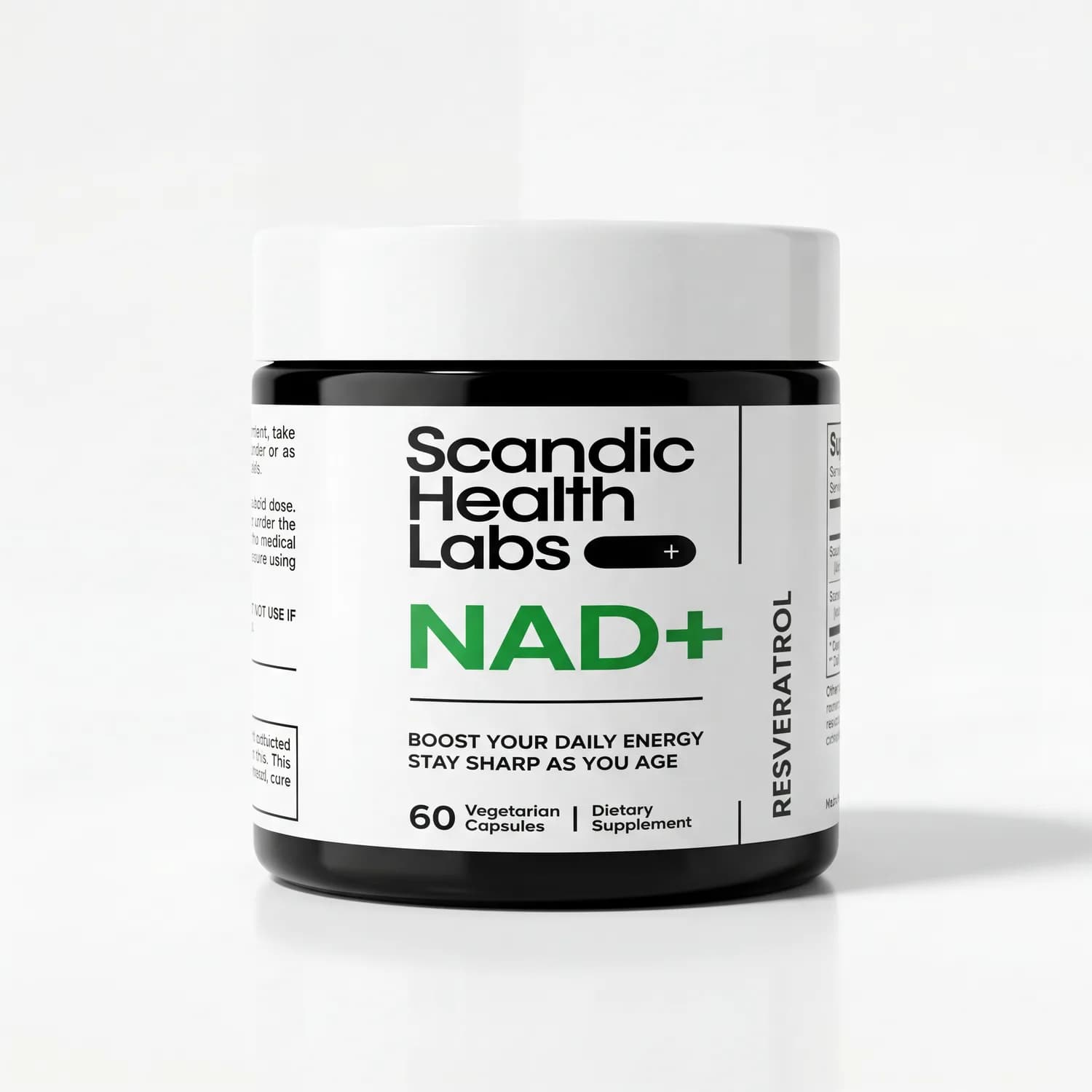
At Scandic Health Labs, we designed our NAD+ formula to reflect what the research actually supports: 500 mg NAD+, 250 mg trans-resveratrol, 150 mg niacinamide, and 100 mg TMG. Four ingredients, clinically informed dosing, and the honest acknowledgement that the best supplement is one grounded in real science — not marketing hype.
8 min read