

How to Choose an NAD+ Supplement: A Buyer's Guide
Not all NAD+ supplements are equal. Learn what to look for — ingredients, dosing, purity, and red flags — so you invest in a formula that actually works.

By Sarah Mitchell

Key takeaways
- —A good NAD+ supplement should contain more than just one ingredient — look for synergistic co-ingredients like resveratrol and TMG
- —Dosing matters: clinical studies typically use 250–500 mg of the core NAD+ ingredient per day
- —Avoid proprietary blends that hide individual ingredient amounts, and watch for underdosed formulas
- —Price alone does not indicate quality, but extremely cheap options almost always cut corners
The NAD+ Supplement Boom — and Why It Can Be Confusing
NAD+ (nicotinamide adenine dinucleotide) has moved from niche biohacking circles into the mainstream. A quick search for "best NAD+ supplement" returns hundreds of options at wildly different price points, with labels that range from refreshingly transparent to deliberately misleading.
The core promise is real: NAD+ levels decline roughly 50% by middle age, and research suggests that restoring those levels may support cellular energy, DNA repair, and the activity of sirtuin enzymes — sometimes called the "longevity genes." But not every supplement on the shelf delivers on that promise equally.
This guide walks you through exactly what to evaluate before you buy.
Understanding the Different NAD+ Pathways: NMN vs NR vs Direct NAD+
The first thing you will notice is that NAD+ supplements come in different forms. Each one takes a slightly different route to raise NAD+ levels in your cells.
Direct NAD+
Some formulas supply NAD+ itself. The molecule is large, and there has been debate about oral bioavailability. However, emerging research suggests that oral NAD+ supplementation does raise blood and tissue NAD+ levels meaningfully. A 2023 multi-centre trial (Yi et al.) using oral NAD+ precursors at 300–900 mg/day showed significant increases in NAD+ metabolites and improved performance on the six-minute walking test.
NMN (Nicotinamide Mononucleotide)
NMN is a direct precursor to NAD+ — your body converts it in one enzymatic step. It gained popularity through the work of David Sinclair at Harvard and has a growing body of human clinical data behind it. The landmark Yoshino et al. (2021) trial used 250 mg/day and found improved muscle insulin sensitivity in postmenopausal women over 10 weeks.
NR (Nicotinamide Riboside)
NR is another NAD+ precursor, converted in two enzymatic steps. It was the first NAD+ precursor to receive FDA GRAS (Generally Recognised as Safe) status and has solid safety data from multiple human trials, including the Igarashi et al. (2022) study that showed reduced arterial stiffness at 250 mg/day.
Which one is best?
A 2026 head-to-head comparison found that NAD+ precursors comparably elevate chronic baseline NAD+ levels, while plain niacinamide (basic vitamin B3) only produces a transient rise. The honest answer: the science has not yet declared a clear winner among NMN, NR, and direct NAD+. What matters more is dosing, purity, and what else is in the formula.
The Ingredients That Actually Matter
A single-ingredient NAD+ capsule is a starting point, but it is not the full picture. Longevity researchers — including those whose personal supplement stacks are public — rarely take NAD+ alone. Here is why.
Resveratrol: The Activator
NAD+ fuels sirtuin enzymes; resveratrol activates them. Think of NAD+ as the fuel and resveratrol as the ignition key. Research shows NAD+ levels increased 1.59x in heart tissue and 1.72x in skeletal muscle when combined with resveratrol compared to NAD+ alone.
Look for trans-resveratrol (the bioactive form), ideally standardised to 98–99% purity. A meaningful dose is 150–250 mg per serving. Anything under 100 mg is likely there for label appeal rather than function.
TMG (Trimethylglycine): The Protector
When your body metabolises NAD+ and its precursors, it uses up methyl groups — small molecular units needed for hundreds of biochemical reactions. Without replenishment, homocysteine levels can rise, which is an independent cardiovascular risk factor.
TMG donates methyl groups to convert homocysteine back into the beneficial amino acid methionine. It is the responsible companion ingredient that most budget formulas leave out. A dose of 50–100 mg or more is what you want to see.
Vitamin B3 (Niacinamide): The Backup Pathway
Niacinamide feeds the NAD+ salvage pathway — your body's internal recycling system for NAD+. It provides a secondary route to maintain NAD+ levels throughout the day. Unlike niacin, niacinamide does not cause flushing. A dose of 100–200 mg complements direct NAD+ supplementation well.
Dosing: What the Clinical Evidence Supports
The majority of positive clinical trials used daily doses in the range of 250–500 mg of the primary NAD+ ingredient:
- —Yoshino et al. (2021): 250 mg/day for 10 weeks — improved insulin sensitivity
- —Igarashi et al. (2022): 250 mg/day for 12 weeks — reduced arterial stiffness
- —Yi et al. (2023): 300–900 mg/day — improved six-minute walking test
- —Liao et al. (2021): NAD+ precursor supplementation improved aerobic capacity in 48 amateur runners
If a supplement provides less than 200 mg of its core NAD+ ingredient per serving, it is likely underdosed relative to what clinical research has tested.
Red Flags: What to Avoid
Proprietary blends
A "proprietary blend" lists several ingredients but only gives the total weight of the blend, not the individual amounts. This makes it impossible to know whether you are getting a meaningful dose of any single ingredient. Transparent brands list every ingredient with its exact amount per serving.
Underdosed formulas
Some supplements include trendy ingredients at doses far below what studies used — just enough to put the name on the label. If a formula contains 50 mg of resveratrol or 25 mg of TMG, those amounts are unlikely to deliver the synergistic benefits the research describes.
Mega-dose claims without evidence
On the other end, some brands push extremely high doses (1,000+ mg) as a selling point. While human safety data is reassuring up to around 1,250 mg/day, higher does not automatically mean better. The clinical sweet spot, based on current evidence, sits in the 250–500 mg range for the primary ingredient.
Unnecessary fillers and additives
Check the "Other Ingredients" section. Titanium dioxide, carnauba wax, talc, artificial colours, and artificial sweeteners have no business in a premium supplement. A clean formula uses minimal excipients — typically just the capsule shell and a flow agent like microcrystalline cellulose.
Price Tiers: What You Get at Each Level
Budget (under 1 EUR/day)
Typically single-ingredient capsules — plain niacinamide, basic NMN powder, or generic NAD+ at low doses. You get the core molecule, but often without co-ingredients, without third-party purity testing, and sometimes at doses below what clinical trials used. Fine for dipping your toe in; limited for serious supplementation.
Premium (roughly 2–3 EUR/day)
Multi-ingredient formulas that combine an NAD+ source with synergistic co-ingredients like resveratrol, TMG, and B3. Clinically relevant dosing. Transparent labels. Clean excipient profiles. This is where the longevity research stack meets practical daily supplementation.
Ultra-premium (5+ EUR/day)
Clinic-grade protocols, liposomal delivery formats, IV NAD+ infusions, or peptide-based approaches. These can be effective but are typically inaccessible for daily use and not necessarily superior to a well-formulated oral supplement at the premium tier.
A Practical Checklist Before You Buy
- Core ingredient at 250–500 mg per serving — whether that is NAD+, NMN, or NR
- Trans-resveratrol included at 150–250 mg — for sirtuin activation
- TMG included at 50–100+ mg — for methylation support
- Transparent label — every ingredient with its exact dose, no proprietary blends
- Clean formula — free from titanium dioxide, artificial colours, unnecessary fillers
- Reasonable price — you should not need to overpay, but under 1 EUR/day usually means compromises
- Suggested use of 2 capsules daily with a meal — fat in the meal may support resveratrol absorption
The Bottom Line
The NAD+ supplement market is growing fast, and quality varies enormously. The best formulas combine a clinically dosed NAD+ source with synergistic ingredients — resveratrol to activate sirtuins, TMG to protect methylation, and B3 to feed the salvage pathway — in a transparent, clean-label package.
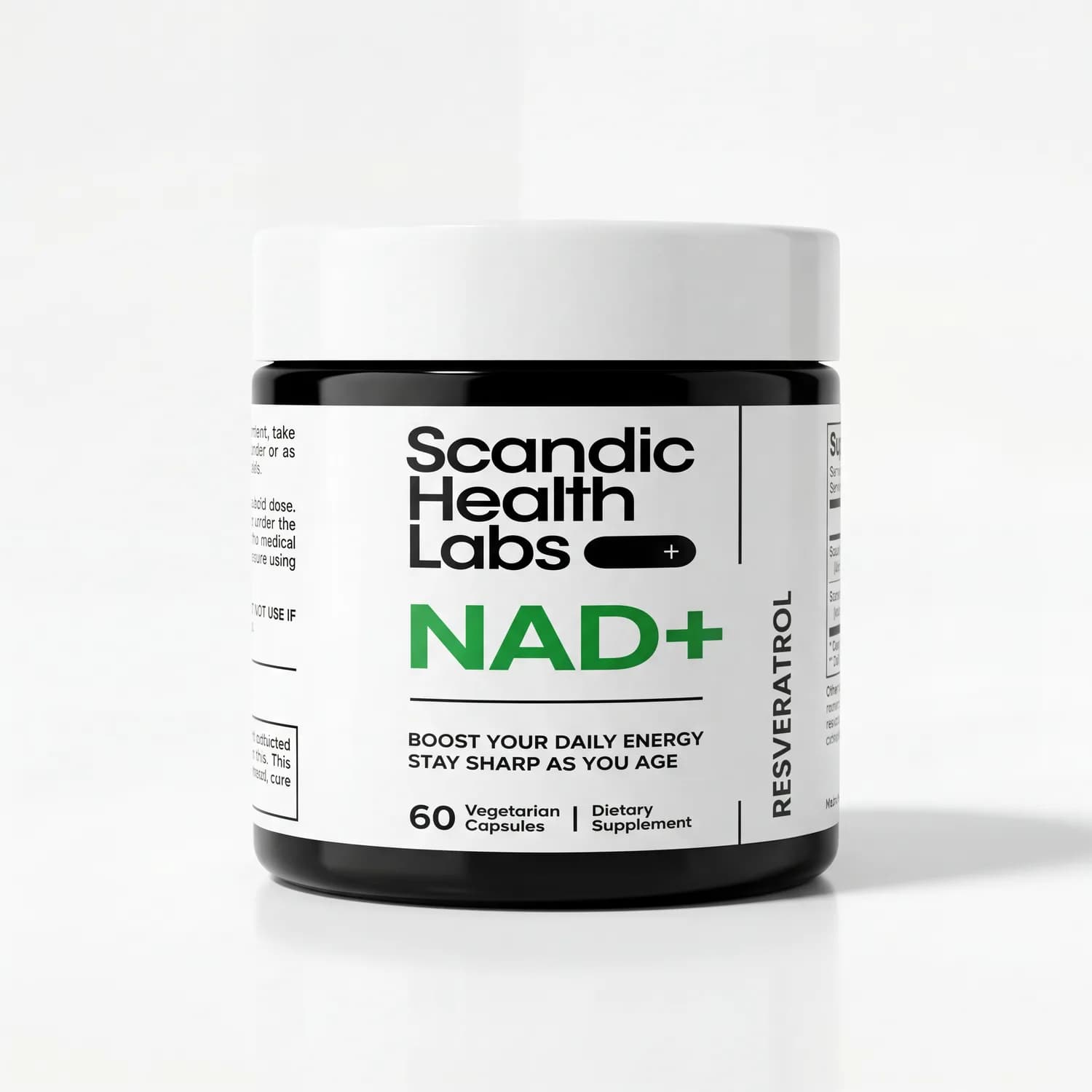
At Scandic Health Labs, we built our NAD+ formula around exactly this principle: 500 mg NAD+, 250 mg trans-resveratrol, 150 mg niacinamide, and 100 mg TMG in two daily capsules. It is the complete longevity stack in one bottle — no proprietary blends, no unnecessary additives, and every ingredient at a dose that reflects what the research actually used.
8 min read