

Resveratrol and NAD+: The Science Behind the Synergy
Why combining NAD+ with trans-resveratrol produces stronger results than either alone — the fuel-and-accelerator model backed by sirtuin research.

By Emma Clarke

Key takeaways
- —NAD+ and resveratrol activate different parts of the same longevity pathway — sirtuins need both to function optimally
- —Research shows NAD+ levels increased 1.59x in heart tissue and 1.72x in skeletal muscle when combined with resveratrol versus NAD+ alone
- —Resveratrol activates SIRT1 (the "longevity sirtuin"), while NAD+ provides the fuel SIRT1 needs to work
- —The quality of resveratrol matters: 99% trans-resveratrol is the biologically active form
- —This synergy is why leading longevity researchers take both compounds together
Two Molecules, One Pathway
If you've spent any time reading about longevity science, you've likely encountered both NAD+ and resveratrol. They appear in the same research papers, the same supplement stacks, the same interviews with aging researchers. But most explanations stop at "they're both good for aging" without explaining *why they work better together*.
The answer lies in a family of enzymes called sirtuins — and in how NAD+ and resveratrol each play a different, complementary role in activating them.
Sirtuins: The Enzymes at the Centre of Longevity Research
Sirtuins are a family of seven enzymes (SIRT1 through SIRT7) that regulate some of the most fundamental processes in your cells. They control mitochondrial biogenesis (creating new cellular powerhouses), DNA repair, inflammation, fat metabolism, stress resistance, and chromatin remodeling (how your genes are expressed).
They are sometimes called "longevity genes" — not because they directly determine lifespan, but because their activity is closely linked to the biological processes that determine how well your cells age.
Here's the critical detail: sirtuins are NAD+ dependent enzymes. They literally cannot function without NAD+. Every time a sirtuin performs its work — deacetylating a protein, repairing a section of DNA, switching on mitochondrial production — it consumes one molecule of NAD+.
This is where the two-molecule story begins.
The Fuel and Accelerator Model
David Sinclair's research group at Harvard Medical School has done more than perhaps any other lab to elucidate the relationship between NAD+, resveratrol, and sirtuins. Their work provides a useful framework:
NAD+ is the fuel. Resveratrol is the accelerator.
Think of SIRT1 — the most-studied sirtuin — as an engine. NAD+ is the petrol that powers it. Without fuel, the engine sits idle no matter how hard you press the accelerator. But with a full tank and no one pressing the pedal, the engine idles — functional, but not doing much.
Resveratrol acts as a SIRT1 activator. It binds to SIRT1 and increases its activity, essentially pressing the accelerator pedal. But this only works if there's enough NAD+ available to fuel the reaction.
This is why supplementing with either molecule alone produces limited results compared to taking both. High NAD+ without sirtuin activation means the fuel is available but underutilised. High resveratrol without adequate NAD+ means you're pressing the accelerator with an empty tank.
The Numbers: What the Research Shows
The synergy isn't just theoretical. Quantitative research demonstrates that combining NAD+ with resveratrol produces measurably higher NAD+ tissue levels than NAD+ supplementation alone:
- —Heart tissue: NAD+ levels increased 1.59 times when combined with resveratrol compared to NAD+ alone
- —Skeletal muscle: NAD+ levels increased 1.72 times with the combination
These aren't marginal differences. A 59-72% improvement in tissue NAD+ levels represents a meaningful enhancement in the cellular environment where sirtuins operate. The likely mechanism is that resveratrol-driven SIRT1 activation improves the efficiency of NAD+ utilisation and may upregulate NAD+ biosynthesis pathways.
Why SIRT1 Matters So Much
Of the seven sirtuins, SIRT1 has received the most research attention — and for good reason. Its downstream effects touch nearly every aspect of cellular health:
Mitochondrial biogenesis
SIRT1 activates PGC-1α, the master regulator of mitochondrial production. More active SIRT1 means more mitochondria, which means greater cellular energy capacity. This is particularly relevant for tissues with high energy demands: brain, heart, and skeletal muscle.
Fat metabolism
SIRT1 promotes the shift from fat storage to fat oxidation. It activates genes involved in fatty acid breakdown and suppresses those involved in fat synthesis. This is one reason why sirtuin-activating compounds have attracted interest in metabolic health research.
Inflammation regulation
SIRT1 deacetylates NF-κB, the master inflammatory transcription factor, reducing its activity. Chronic low-grade inflammation — sometimes called "inflammaging" — is one of the primary drivers of NAD+ depletion in the first place. By suppressing NF-κB, SIRT1 may help break the inflammatory cycle that depletes NAD+.
DNA repair coordination
While PARPs handle the direct mechanical work of DNA repair, SIRT1 coordinates the broader cellular response to DNA damage — deciding which repair pathways to activate and managing the chromatin remodeling needed to access damaged DNA.
Trans-Resveratrol vs. Cis-Resveratrol: Why Purity Matters
Not all resveratrol is created equal. The molecule exists in two forms: *trans*-resveratrol and *cis*-resveratrol. They have the same atoms but different spatial arrangements, and this difference matters enormously for biological activity.
Trans-resveratrol is the biologically active form. It's the configuration that binds to SIRT1, crosses the blood-brain barrier, and produces the cardiovascular and neuroprotective effects seen in research. Virtually all published studies on resveratrol's health benefits used the trans form.
Cis-resveratrol is the inactive isomer. It forms when trans-resveratrol is exposed to light, heat, or poor storage conditions. It has significantly reduced biological activity and does not activate SIRT1 effectively.
This is why standardisation matters. A supplement labelled "250 mg resveratrol" could contain a mixture of both forms, with an unknown proportion of the active trans configuration. Look for products standardised to 99% trans-resveratrol — typically sourced from *Polygonum cuspidatum* (Japanese knotweed) root extract, which is the most reliable botanical source of high-purity trans-resveratrol.
Beyond Sirtuins: Resveratrol's Independent Benefits
While the sirtuin activation story is the primary reason to combine resveratrol with NAD+, resveratrol brings additional benefits to the formula:
Cardiovascular support
Resveratrol supports endothelial function — the health of the cells lining your blood vessels. It promotes nitric oxide production, which helps maintain healthy blood flow and blood pressure. Multiple clinical trials have documented improvements in arterial function with resveratrol supplementation.
Neuroprotection
Resveratrol is one of the few polyphenols that crosses the blood-brain barrier. Once there, it may support neuronal health through antioxidant activity, anti-inflammatory effects, and direct modulation of neuroprotective signalling pathways.
Antioxidant defence
As a polyphenol, resveratrol is a potent scavenger of reactive oxygen species (ROS). This complements NAD+'s role in fuelling the sirtuin-driven antioxidant response (particularly through SIRT3, which activates the mitochondrial antioxidant enzyme SOD2).
Why Leading Researchers Take Both
It's worth noting that many prominent longevity researchers — including David Sinclair himself — have publicly shared that their personal supplement protocols include both NAD+ precursors and resveratrol. This isn't a coincidence or a marketing talking point. It reflects the biochemical logic: the two molecules address different bottlenecks in the same critical pathway.
Sinclair's 2013 study (Gomes et al.) demonstrated that declining NAD+ disrupts nuclear-mitochondrial communication through a pseudohypoxic state — and that restoring NAD+ can reverse this disruption. His broader body of work consistently emphasises that sirtuin activation requires both adequate NAD+ supply and direct sirtuin stimulation.
Practical Implications: Building a Synergistic Stack
If the science of NAD+ and resveratrol synergy tells us anything practical, it's this: taking these molecules together is more effective than taking either alone. A well-designed formula should include:
- Direct NAD+ supply — to raise cellular NAD+ levels and provide the fuel sirtuins need
- High-purity trans-resveratrol — to activate SIRT1 and amplify the effect of elevated NAD+
- Supporting ingredients — like niacinamide (to feed the NAD+ salvage pathway) and TMG (to replenish methyl groups consumed during NAD+ metabolism)
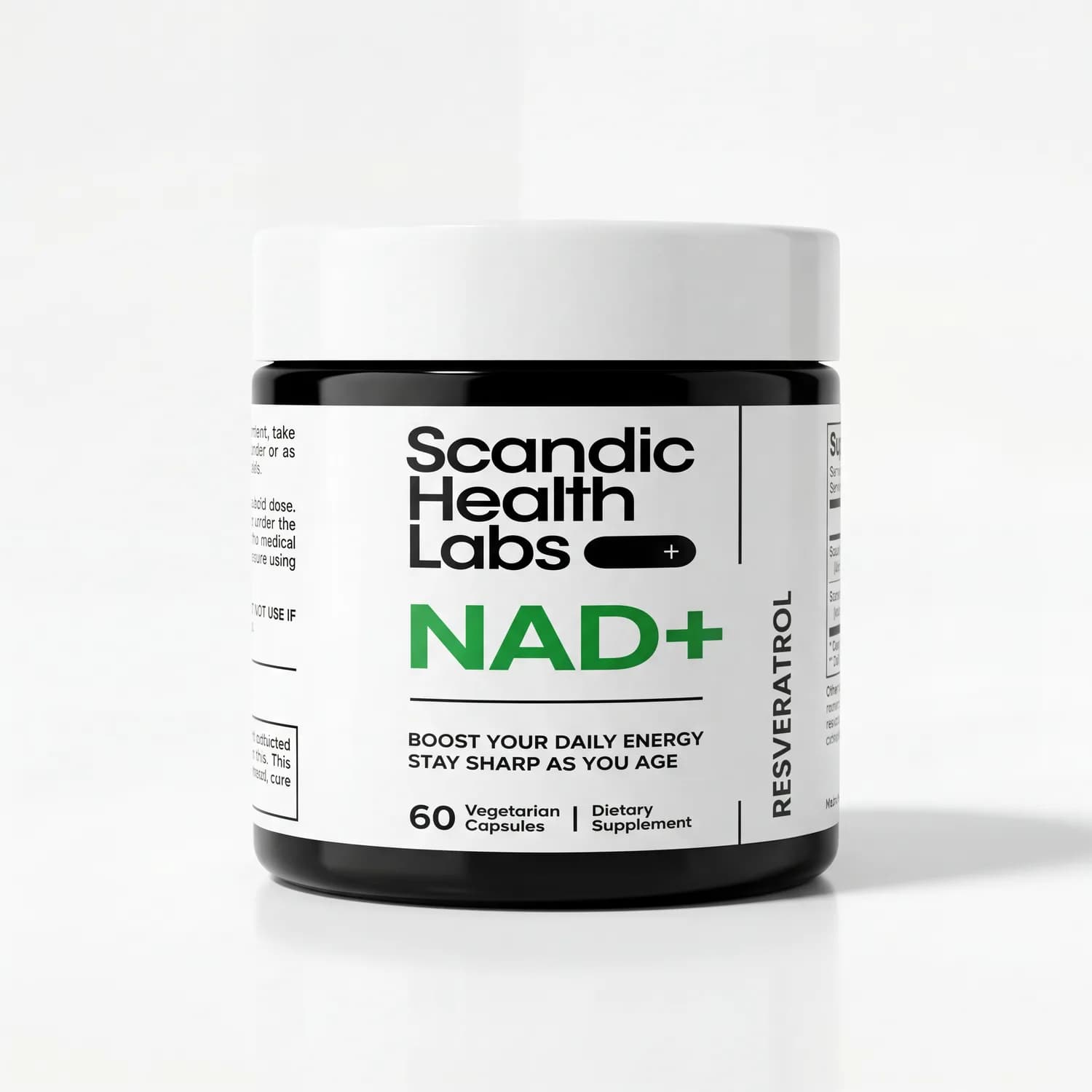
This is precisely the rationale behind the Scandic Health Labs NAD+ formula: 500 mg NAD+, 250 mg trans-resveratrol standardised to 99% purity, 150 mg niacinamide, and 100 mg TMG. Four ingredients, one integrated longevity stack — because the science shows that synergy outperforms any single ingredient.
Two capsules daily, with a meal. That's the complete protocol.
7 min read