

What Is NAD+ and Why Does It Matter After 35?
NAD+ is a molecule your cells need for energy, DNA repair, and healthy aging. After 35, levels drop fast. Here's what the science says and what you can do about it.

By Emma Clarke

Key takeaways
- —NAD+ is a coenzyme present in every cell, essential for energy production, DNA repair, and activating longevity-related genes
- —NAD+ levels decline roughly 50% by age 50, contributing to fatigue, slower recovery, and accelerated aging
- —Supplementation may help restore NAD+ levels and support cellular function as you age
A Molecule You've Never Heard Of Is Running Your Entire Body
There is a molecule inside every one of your cells that quietly keeps you alive. It helps turn your food into energy. It repairs damaged DNA. It activates a family of genes that scientists have linked to longevity. And unless you have a background in biochemistry, you have probably never heard of it.
It is called NAD+ — nicotinamide adenine dinucleotide. The name is a mouthful, but the concept is straightforward: NAD+ is a coenzyme that participates in over 500 enzymatic reactions in your body. Without it, your cells simply cannot function.
And here is the uncomfortable part: your NAD+ levels are declining right now. They have been declining since your twenties. By the time you reach 50, research suggests you may have lost roughly half the NAD+ you had at 20. That decline is not just a number on a lab report — it shows up as lower energy, slower recovery, and the gradual erosion of cellular health that we call aging.
What Does NAD+ Actually Do?
Think of NAD+ as a universal helper molecule. It does not do one thing — it enables hundreds of things to happen. But three of its roles matter most for understanding why it is so important.
1. Energy Production
Your mitochondria — the power generators inside every cell — need NAD+ to produce ATP, the molecule your body uses as energy currency. NAD+ acts as an electron carrier in the metabolic pathways that convert food into usable energy: glycolysis, the citric acid cycle, and oxidative phosphorylation.
When NAD+ levels are high, your mitochondria run efficiently. When they drop, energy production slows down. That afternoon slump you blame on lunch? Part of it may be a cellular energy problem, not just a blood sugar dip.
2. DNA Repair
Your DNA takes damage every single day — from UV light, from oxidative stress, from normal metabolic activity. Your cells have a repair crew for this: PARP enzymes (poly-ADP-ribose polymerases). These enzymes detect single-strand DNA breaks and fix them before they become serious problems.
But PARP enzymes run on NAD+. It is their sole fuel source. When NAD+ is abundant, DNA repair happens quickly and efficiently. When NAD+ is depleted, damage accumulates. Over time, that unrepaired damage contributes to aging and cellular dysfunction.
3. Sirtuin Activation — The Longevity Genes
This is where the story gets particularly interesting. NAD+ fuels a family of seven enzymes called sirtuins (SIRT1 through SIRT7), sometimes referred to as "longevity genes." Sirtuins regulate a remarkable range of biological processes:
- —SIRT1 drives mitochondrial biogenesis (the creation of new mitochondria) and fat metabolism
- —SIRT3 protects against oxidative stress inside mitochondria
- —SIRT6 helps maintain telomere integrity — the protective caps on your chromosomes
A landmark 2013 study from David Sinclair's lab at Harvard (Gomes et al.) showed that declining NAD+ creates what they called a "pseudohypoxic state" — essentially, your cells start behaving as though they are starved of oxygen, even when oxygen is plentiful. This disrupts the communication between the nucleus and mitochondria and accelerates aging. The good news from that research: restoring NAD+ levels reversed the effect.
Without adequate NAD+, sirtuins go quiet. With it, they get back to work.
The Age Decline: What Happens After 35
NAD+ levels do not drop overnight. It is a gradual process that begins in your twenties and accelerates through your thirties and forties. By age 50, studies measuring NAD+ across human skin, blood, liver, muscle, and brain tissue consistently show roughly a 50% decline compared to age 20.
Why does this happen? Three mechanisms drive the decline:
- —Increased consumption: Chronic low-grade inflammation — which rises naturally with age — activates enzymes like CD38 and PARP that consume large amounts of NAD+. The more inflammation, the faster NAD+ gets used up.
- —Decreased production: The NAMPT enzyme, which is responsible for recycling NAD+ through the salvage pathway, loses efficiency as you age. Your body produces less NAD+ from the raw materials available.
- —A vicious cycle: Low NAD+ causes mitochondrial dysfunction. Dysfunctional mitochondria produce more oxidative stress. Oxidative stress further depletes NAD+. The cycle feeds itself.
This is not a theoretical problem. Research has connected declining NAD+ levels to reduced exercise capacity, slower wound healing, impaired cognitive function, weakened immune response, and the metabolic changes associated with aging.
Can You Restore NAD+ Levels?
This is the question that has driven an enormous wave of research over the past decade. And the answer, based on current evidence, is encouraging.
The Clinical Evidence
A 2021 study at Washington University (Yoshino et al.) gave postmenopausal women with prediabetes an NAD+ precursor at 250 mg per day for 10 weeks. The result: muscle insulin sensitivity improved by approximately 25%, with favorable changes in gene expression related to lipid metabolism.
A 2022 randomized, double-blind, placebo-controlled trial at Keio University (Igarashi et al.) found that 250 mg per day for 12 weeks was safe, elevated NAD+ metabolism markers, and showed potential for reducing arterial stiffness.
A multi-center randomized controlled trial (Yi et al., 2023) demonstrated that 300-900 mg per day significantly raised NAD+ levels and improved the six-minute walking test in 80 middle-aged adults — a direct measure of physical capacity.
What Lifestyle Supports NAD+
Supplementation is not the only approach. Several lifestyle factors support NAD+ levels:
- —Exercise — particularly aerobic exercise — stimulates NAMPT, the enzyme that recycles NAD+
- —Caloric restriction and intermittent fasting have been shown to upregulate NAD+ production
- —Good sleep supports circadian rhythm regulation, which is linked to NAD+ cycling
- —Reducing chronic inflammation through diet, stress management, and movement helps slow NAD+ consumption
That said, the age-related decline in NAD+ is significant enough that lifestyle alone may not fully compensate, especially after 40. This is where targeted supplementation comes in.
Why a Multi-Ingredient Approach Makes Sense
Most NAD+ supplements on the market contain a single ingredient — either NAD+ itself or a precursor like NMN or NR. That is a reasonable starting point, but it misses the bigger picture.
NAD+ works within a network. It fuels sirtuins, but sirtuins need activation. It gets metabolized by the body, consuming methyl groups in the process. The salvage pathway that recycles NAD+ benefits from additional precursor support.
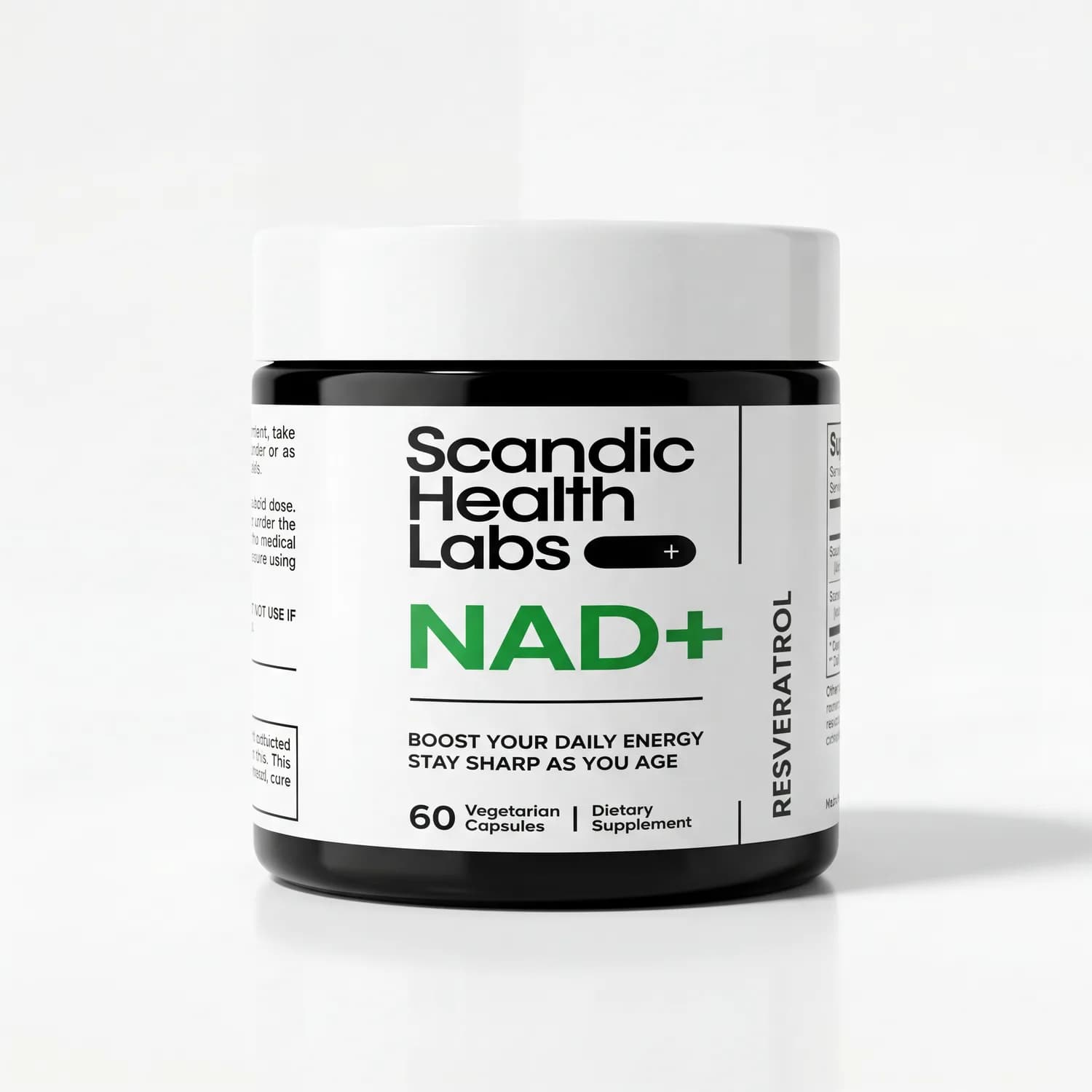
This is why the Scandic Health Labs NAD+ formula combines four ingredients: 500 mg of NAD+, 250 mg of trans-resveratrol (to activate sirtuins), 150 mg of vitamin B3 as niacinamide (to support the salvage pathway), and 100 mg of TMG (to replenish the methyl groups that NAD+ metabolism consumes). Each ingredient has a specific role, and together they address the full NAD+ cycle — not just one piece of it.
The Bottom Line
NAD+ is not a trend or a marketing buzzword. It is a fundamental molecule that your cells depend on for energy, repair, and healthy function. The science documenting its decline with age is robust, and the research into restoring it is growing every year.
If you are over 35 and noticing changes in your energy, recovery, or overall vitality, NAD+ is worth understanding. Not as a miracle cure — the science does not support that language — but as a meaningful piece of the cellular health puzzle.
The best time to start supporting your NAD+ levels was ten years ago. The second best time is now.
8 min read